Is Hormone Replacement Therapy Safe? Risks & Benefits
Is HRT safe? Learn how current evidence, FDA labeling changes, treatment timing, hormone type, route, and health history shape HRT risks and benefits.

Menopause & Women's Health Series Part 3 of 6
By Erin Boumansour
If you are trying to figure out whether you are in perimenopause, you may have heard two completely different messages.
One person tells you, “Get your hormones checked.”
Another tells you, “Hormone testing is useless during perimenopause.”
That can make an already confusing stage of life even more frustrating.
The reality is more useful than either extreme:
Most women do not need a hormone blood test to prove that they are in perimenopause or menopause. But that does not mean lab testing never has a role.
There is also an important difference between testing hormone levels to diagnose perimenopause and obtaining baseline labs before starting treatment. We'll separate those two questions below.
The important question is not simply:
“Should I test my hormones?”
It is:
“What question are we trying to answer with the test?”
That distinction can save you from chasing numbers that may not tell you very much—and help you recognize when testing really can add clarity.
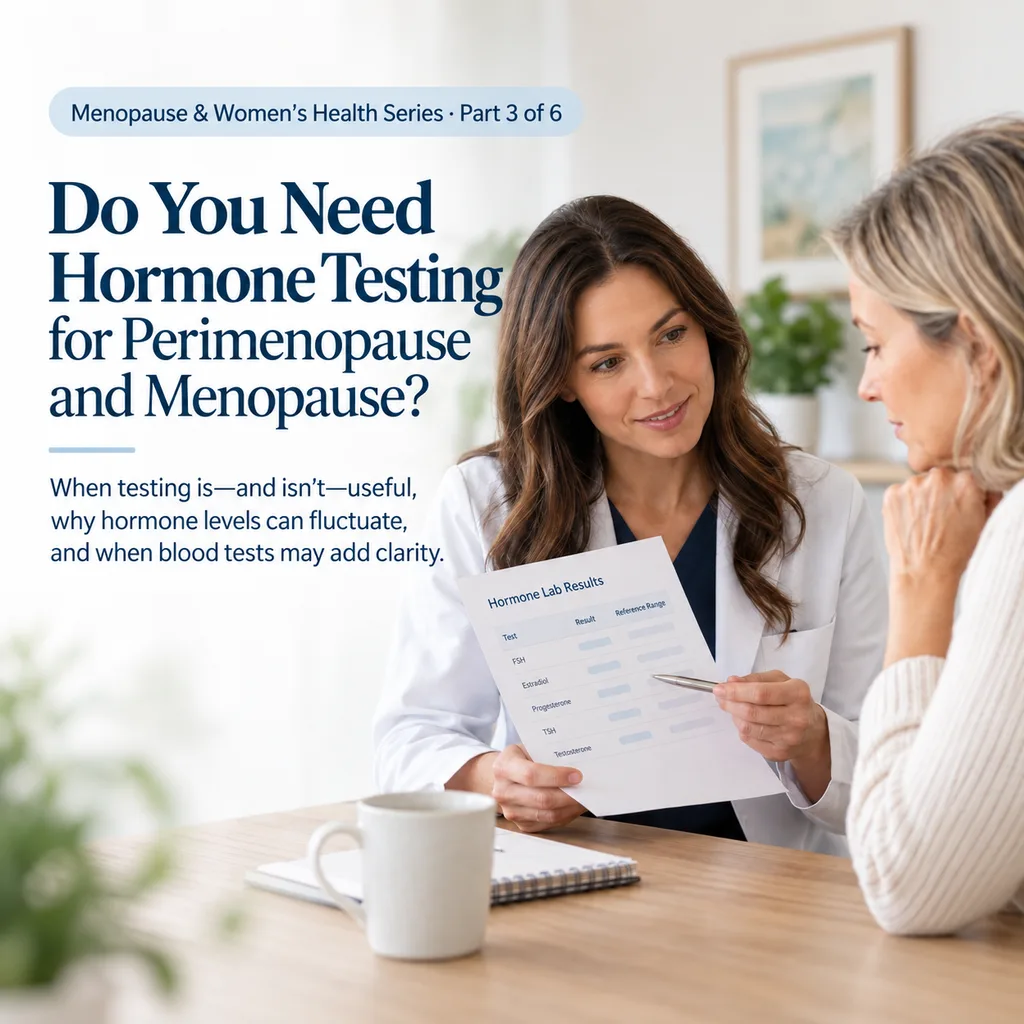
If you are in your mid-40s or older and your periods are changing along with symptoms that fit the menopause transition, a clinician can often recognize perimenopause from your history without needing a hormone test.
That history may include:
ACOG advises that most women do not need hormone testing during typical perimenopause. Age, symptoms, and menstrual changes usually provide more useful information.
That may sound surprising when so much attention is placed on estrogen, progesterone, and FSH.
But there is an important reason.
Perimenopause is not a steady decline from “normal hormones” to “menopausal hormones.”
Ovarian hormone production becomes increasingly unpredictable.
Estrogen may be relatively high at one point and lower at another. Ovulation becomes less consistent. Progesterone production changes when ovulation does not occur. FSH—the hormone your brain uses to signal the ovaries—can rise and fall considerably during the transition.
That means a blood test is capturing one moment in a process that is constantly changing.
You could have an FSH level that looks elevated one day and a very different result at another point in the transition.
A single “normal” hormone result therefore does not mean:
“You are definitely not in perimenopause.”
And one elevated result does not necessarily provide a complete picture of where you are in the transition.
ACOG notes that hormone levels change a lot during the menopause transition, which is why testing usually does not add much when age, symptoms, and menstrual changes already fit typical perimenopause.
This is one of the biggest reasons symptoms and menstrual patterns matter so much.
Menopause is technically a point in time.
For someone who is still having natural menstrual cycles, menopause is confirmed after 12 consecutive months without a period, assuming there is no other explanation for the absence of menstruation.
You usually do not need an estradiol or FSH result to prove that this happened.
Perimenopause is harder to reduce to a single test because it is the transition leading up to that point—and fluctuation is part of the biology.
That is also why there is no one blood test that can tell you exactly:
“You are 42% of the way through perimenopause.”
The Menopause Society recently highlighted this problem in research on women’s uncertainty about perimenopause: there is no laboratory biomarker that definitively determines the perimenopause stage.
There are situations where hormone testing deserves more consideration.
Age changes the decision.
If menopause-associated symptoms or menstrual changes begin before age 45, clinicians may be more likely to use laboratory testing as part of the evaluation.
Between ages 40 and 45, FSH may be considered when early menopause is suspected.
Before age 40, menstrual changes or symptoms raise a different concern: primary ovarian insufficiency, or POI.
In that situation, hormone testing becomes much more important. Evaluation commonly includes FSH and estradiol, and an abnormal FSH result is generally confirmed rather than relying on one isolated test.
The reason for looking more closely is not simply to attach a label. Loss of ovarian function at a younger age has different implications for fertility, bone health, cardiovascular health, and long-term care.
Periods normally provide valuable clues about the menopause transition.
But not everyone has that information.
For example, someone who has had a hysterectomy may no longer have menstrual bleeding to help show where she is in the transition.
In people 45 or older who have had a hysterectomy, NICE recommends identifying menopause based on the type and combination of symptoms rather than routine laboratory testing.
The absence of periods changes the history, but it does not automatically make hormone testing necessary.
The same principle still applies:
Testing should answer a specific question.
Sometimes the bigger value of lab testing is not confirming menopause.
It is asking whether something else may also be contributing.
Fatigue, brain fog, sleep problems, palpitations, mood changes, cycle changes, weight changes, and heat intolerance can all occur during the menopause transition.
They can also overlap with other health conditions.
Depending on the situation, a clinician may decide that the more useful testing is aimed at questions involving thyroid function, pregnancy, anemia or iron status, prolactin, metabolic health, or another potential contributor.
That does not mean menopause is being dismissed.
It means the evaluation is broad enough not to assume that every symptom has only one explanation.
This distinction is important.
A hormone panel can provide useful information about individual hormone markers when there is a clinical reason to look at them.
But ordering a broad panel is not the same thing as having a test that definitively diagnoses perimenopause.
If your provider decides hormone testing would be useful, the meaning of the results depends on things such as:
If you want a deeper explanation of individual markers such as estradiol, progesterone, testosterone, SHBG, FSH, LH, DHEA-S, and prolactin, our What Does a Hormone Panel Show? guide goes into those markers individually.
For menopause care, though, the numbers should support the clinical picture—not replace it.
Before starting systemic hormone therapy, the first step is a clinician-guided evaluation—not simply deciding whether one hormone level is “normal” or “abnormal.”
At purelyIV, we generally want to review recent baseline labs before starting HRT, and your NP may recommend updated testing when needed. The purpose is to understand your overall health, look for other factors that could be contributing to your symptoms, identify information that could affect treatment decisions, and establish a useful baseline for follow-up.
That is different from using FSH, estradiol, or another hormone value to prove that you are in perimenopause.
ACOG does not recommend routine hormone-level testing before starting hormone therapy for typical menopausal symptoms. That guidance is specifically about using hormone levels as a routine prerequisite. It does not mean that baseline clinical evaluation or appropriate lab testing should be skipped before treatment.
Which labs are appropriate—and whether hormone levels themselves would add useful information—depends on your age, symptoms, menstrual history, medications, medical history, previous results, and the treatment being considered.
Starting HRT is a clinician-guided decision. Your NP reviews the full clinical picture and determines what testing is appropriate before treatment begins.
We will go much deeper into hormone therapy, nonhormonal options, and supportive care in Part 4 of this series.
You may also see over-the-counter menopause tests that measure FSH in urine.
These tests can detect whether FSH is elevated at the time you take the test.
That is not the same as diagnosing menopause or perimenopause.
The FDA specifically notes that home FSH tests can detect elevated FSH but do not determine whether you are definitely in menopause or perimenopause. FSH can rise and fall during the transition, so both positive and negative results have limitations.
A home test also should not be used to determine whether you can still become pregnant or whether contraception is still needed.
If you use one, think of it as one piece of information—not a definitive answer.
There is a strong temptation to think:
If one hormone value is imperfect, maybe testing ten hormones will give me certainty.
But adding more numbers does not automatically solve the underlying problem.
The most useful lab work starts with a clinical question.
Are we trying to understand whether menopause is happening unusually early?
Are we evaluating symptoms that could overlap with thyroid disease or anemia?
Are we trying to understand a specific hormone pattern?
Are we reviewing an existing treatment?
Are we investigating abnormal bleeding?
Different questions call for different testing.
That is far more useful than ordering the largest hormone panel available and hoping the answer appears somewhere in the results.
Whether or not labs are needed, the information you bring to the appointment matters.
Track what has changed from your normal.
That might include:
A pattern collected over weeks or months may tell a clinician much more about your menopause transition than one hormone measurement taken on one morning.
At purelyIV, menopause care does not begin with the assumption that every woman needs the same lab panel.
It begins with a 60–75 minute consultation with a nurse practitioner.
We review your symptoms, menstrual history, health history, medications, goals, and any existing lab results. Because baseline information can be valuable when considering HRT, in most cases we want to review recent labs before treatment and may recommend updated testing when needed.
The goal is not to use one hormone result to prove that you are in perimenopause. It is to make sure we have the clinical information needed to make a thoughtful treatment decision and establish a useful baseline for follow-up.
That is the value of clinician-guided testing:
the lab work follows the clinical question instead of the clinical question following the lab work.
You do not need a hormone test to make your symptoms real.
And for most women in the typical age range with the expected pattern of perimenopause, you do not need one blood test to prove what your body is already showing.
Hormone testing becomes more useful when there is a specific reason for it—especially when menopause may be occurring early, menstrual history is unavailable, the diagnosis is uncertain, another condition may be contributing, or a clinician is trying to answer a defined treatment or hormone question.
The goal is not to collect the most lab results.
It is to get the right information for the decision in front of you.
If your symptoms are affecting the way you sleep, think, work, exercise, feel, or function, that is enough reason to start the conversation.
For the broader path through perimenopause, symptoms, testing, treatment options, safety, and follow-up, visit our Menopause & Perimenopause Guide.
Disclaimer: The information in this article is for educational purposes only and is not a substitute for professional medical advice, diagnosis, or treatment. Talk with a qualified healthcare professional about symptoms, testing, medications, and treatment decisions that apply to you.